
How to Pass the CIRO's Retail Securities Exam (RSE) by CIRO : A Strategic Guide
Nov 13, 2025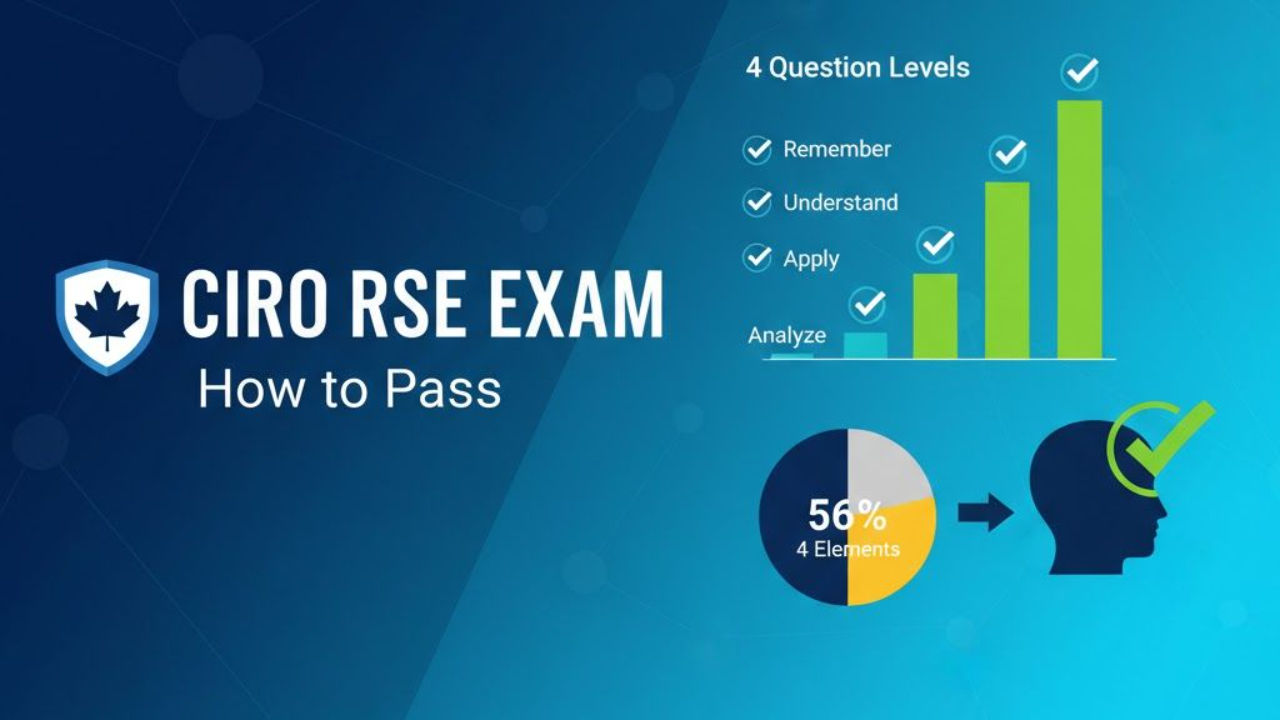
The CIRO Retail Securities Exam (RSE) is the national proficiency standard for Registered Representatives in Canada. It's a comprehensive, case-study-driven exam designed to ensure you have the competency and ethical framework to provide suitable investment advice to retail clients.
Passing isn't just about memorizing facts; it's about proving you can apply them. This guide will break down the exam's structure, the four cognitive levels you'll be tested on, and a proven strategy to focus your efforts and pass.
Phase 1: Understand the Battlefield - The RSE Exam Blueprint
First, let's understand what you're up against. The exam is a three-hour, multiple-choice test with approximately 120-126 questions.
The most critical piece of information isn't the total question count—it's the weighting. The entire exam is built on 9 Elements, but not all are created equal.
Here is the official approximate breakdown:
| Element | Topic | Indicative # of Qs |
| Elem. 1 | Know-Your-Client (KYC) & Suitability | ~27 |
| Elem. 2 | Fixed Income | ~10 |
| Elem. 3 | Equities | ~12 |
| Elem. 4 | Securities Analysis | ~14 |
| Elem. 5 | Managed Products & Other Investments | ~16 |
| Elem. 6 | Portfolio Construction | ~13 |
| Elem. 7 | Investment Recommendations | ~14 |
| Elem. 8 | Execution & Market Integrity | ~7 |
| Elem. 9 | Monitoring & Maintaining Relationships | ~13 |
The Core Strategy: Focus on the "Big Four"
Look at that data. Elements 1, 4, 5, and 7 account for 71 questions—roughly 56% of your entire exam.
Your study strategy must be built around this fact. You must master these four high-weight areas. Spending days trying to memorize the 7 questions in Element 8 while you are still weak on KYC and Suitability (27 questions) is a failing strategy.
Phase 2: Know Your Enemy - The 4 Question Levels
This is not a simple fact-recall exam. CIRO explicitly tests you on four different cognitive levels. You must be able to tell them apart.
1. Remember (The "What")
-
What it is: This is pure definition and fact recall.
-
Key Verbs: Define, list, identify, state, recognize.
-
Example Question: "What is the function of the Canadian Investor Protection Fund (CIPF)?"
2. Understand (The "Why")
-
What it is: This tests your comprehension. Can you explain a concept in your own words?
-
Key Verbs: Explain, describe, compare, contrast, illustrate.
-
Example Question: "Which of the following best describes the role of a trustee in a mutual fund structure?"
3. Apply (The "How")
-
What it is: This is the first case-study level. You are given a scenario and must use a formula or rule.
-
Key Verbs: Apply, calculate, solve, demonstrate.
-
Example Question: "Your client plans to save $5,000 within two years... with a fixed interest rate of 4% p.a. What is the minimum annual deposit to meet the target...?"
4. Analyze (The "Grey Area")
-
What it is: This is the most complex level. You are given a full, multi-part case study with conflicting information (a "grey area") and must make a judgement. You must synthesize multiple concepts (like KYC, product knowledge, and ethics) to find the best course of action.
-
Key Verbs: Analyze, evaluate, determine, justify, critique.
-
Example Question: "A 65-year-old conservative client insists on buying a high-risk penny stock. He understands the risk but it conflicts with his KYC. What is the most important concern when considering this trade?"
Strategic Takeaway: You will not pass by just "Remembering" and "Understanding." The exam is heavily weighted towards "Apply" and "Analyze". This means your studying must be case-study-based.
Phase 3: The Battle Plan - A 5-Step Study Methodology
Follow this plan to study smarter, not harder.
Step 1: Deconstruct the "Big Four"
Start by building your foundation on the high-weight elements. Do not move on until you are confident here.
-
Element 1 (KYC & Suitability): This is your ethical constitution. Master the Client Focused Reforms (CFRs), the 7 suitability obligations, how to collect KYC, and the CIRO Standards of Conduct.
-
Element 5 (Managed Products): You must be a product expert. Know the structure, features, risks, and suitability of mutual funds, ETFs, pooled funds, and structured notes.
-
Element 4 & 7 (Analysis & Recommendations): These go together. Element 4 gives you the tools (fundamental/technical analysis, financial ratios). Element 7 is how you use those tools to make a suitable recommendation and document it.
Step 2: Use Active, Not Passive, Study Techniques
-
Passive (Bad): Re-reading the textbook, highlighting, watching videos without taking notes.
-
Active (Good):
-
Mind Mapping: On a blank page, write "Element 1: Suitability." Now, write down everything you know. This forces your brain to build connections.
-
Teach It: Explain the difference between a common share and a preferred share to a friend or family member. If they don't get it, you don't get it well enough.
-
Flashcards: Use them only for "Remember" and "Understand" concepts (e.g., definitions, formulas).
-
Step 3: Practice, Practice, Practice (the Right Way)
Do not save the mock exams for the end. You must "practice as you play."
-
After Each Element: Do a 20-30 question quiz on just that topic. This confirms your knowledge.
-
The 50% Point: Once you are halfway through the material, do your first full-length mock exam. It will be painful, but it will recalibrate your brain to the speed and difficulty of the real test.
-
Review Every Answer: When you get a question wrong, don't just see the right answer and move on. You must understand why you were wrong and why the correct answer is right. This is the single most valuable study technique.
Step 4: Master the Case Study
Every time you read a practice question, treat it like a real-world client.
-
Read the KYC first: Who is this person? (Age, risk, objective, time horizon).
-
Read the "Problem": What do they want?
-
Identify the Conflict: Where does their want conflict with their need (the KYC)?
-
Find the Best Answer: Eliminate the answers that are illegal, unethical, or simply wrong. You will often be left with two "good" answers. Re-read the question and find the key detail that makes one better than the other.
Step 5: The Final Week
Do not try to learn new material in the last 3-4 days. Your job is to consolidate.
-
Review your mistakes from all your practice exams.
-
Re-read the CIRO Standards of Conduct (Element 1).
-
Get a full night's sleep. A tired brain cannot pass an "Analyze" level exam.
You can do this. The RSE is a challenging but passable exam. It's not about being a math genius; it's about proving you are a diligent, ethical, and competent professional. Good luck.
Buy on Amazon
Stay connected with news and updates!
Join our mailing list to receive the latest news and updates from our team.
Don't worry, your information will not be shared.
We hate SPAM. We will never sell your information, for any reason.